Apply

May 25, 2026

Traffic Laws for Tourists: Essential Rules for Driving Abroad

Maricor Bunal
Maricor Bunal May 25, 2026
Traffic Laws for Tourists: Essential Rules for Driving Abroad

A foreign driver's documents; national license, IDP, insurance, settle the question of legal authorization. Traffic laws settle the question of legal behavior, and those laws vary more sharply than most travelers expect. This guide identifies the eight categories of traffic law that produce the most fines and accidents for foreign drivers, then explains how each category typically differs from US rules. It serves as the template for country-specific articles (e.g., "Traffic Laws for Tourists in Japan," "in France," "in the UAE") that the IDA cluster expands as the topical map grows.

What traffic laws should tourists know before driving abroad?

Tourists should research eight categories of traffic law before driving abroad: which side of the road traffic uses, posted speed limits and their conversion units (km/h vs mph), drink-driving thresholds and zero-tolerance jurisdictions, mobile phone use rules, headlight requirements (daylight running lights in many countries), seat belt and child-seat laws, right-of-way rules at intersections without signals, and roundabout entry rules. Five categories, drink-driving, speed enforcement, mobile phone, seat belts, and roundabouts, produce roughly 80% of foreign-driver fines.

National differences in these eight categories range from minor (1 km/h speed-limit conversions) to fundamental (drive-on-the-left vs drive-on-the-right reversal). Reviewing each category for the destination country before departure prevents the most common rental-car incidents.

Which side of the road do tourists drive on in different countries?

Approximately 76 countries and territories drive on the left, including the United Kingdom, Ireland, Australia, New Zealand, Japan, India, South Africa, most of the Caribbean, and several Southeast Asian and African countries. The remaining 165 countries drive on the right, including the United States, Canada, all of continental Europe, China, all of South America, and most of Africa and the Middle East. The transition between drive-on-the-left and drive-on-the-right countries (Thailand-Malaysia border, China-Pakistan border) is one of the few places in the world where roads switch sides.

Tourists driving on the opposite side from their home country face the highest accident risk in the first 48 hours of foreign driving. Renting an automatic transmission, taking an airport-departure route that avoids complex intersections, and avoiding night driving for the first day reduce the risk substantially.

How do speed limits work for tourists abroad?

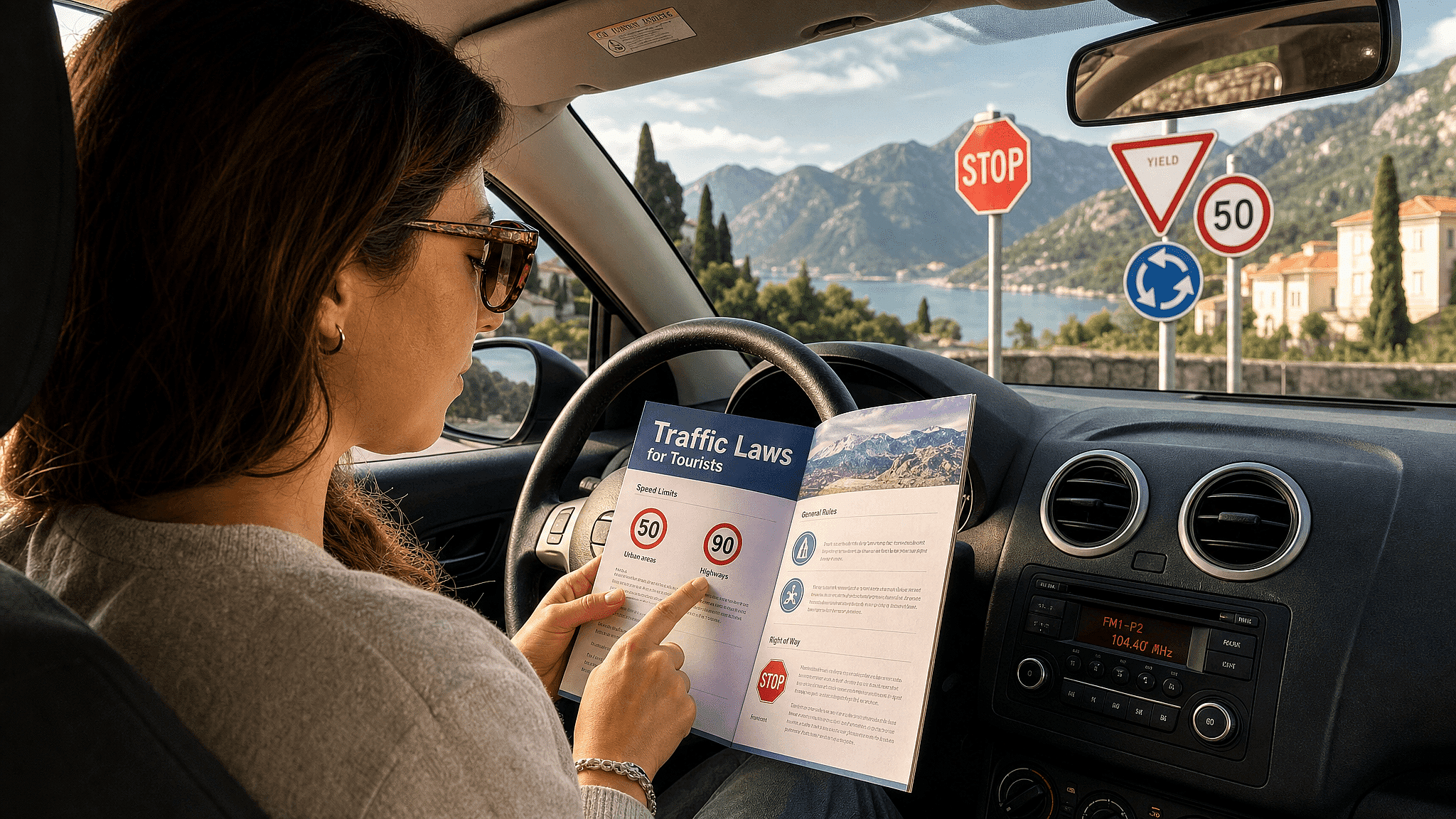
Speed limits abroad use kilometers per hour in every country except the United States, the United Kingdom (which uses mph despite being metric for most other measurements), and a small number of Caribbean and Pacific territories. Posted speed limits are enforced by fixed speed cameras, mobile patrols, and average-speed systems that calculate speed across multiple checkpoints. Many European countries impose stricter limits on foreign-rental vehicles than on resident vehicles in the first 12–24 months, a category called "novice driver" speed limits that applies to foreign drivers in some jurisdictions.

Speed enforcement abroad is generally stricter than in the United States, with penalties starting at the first km/h over the limit rather than at a typical US 10 mph buffer. Speeding fines in Western Europe range from $60 for minor infractions to $1,500+ for major violations, with same-day collection at many checkpoints.

What are the drink-driving rules for tourists?

Drink-driving thresholds for tourists vary widely by country. The United States enforces a 0.08% blood alcohol concentration (BAC) limit. Most of Europe enforces 0.05%, with some countries (Sweden, Norway, Poland, Czech Republic, Hungary, Slovakia) enforcing 0.02% or 0.00%. Zero-tolerance jurisdictions where any detectable alcohol triggers a violation include Saudi Arabia, the United Arab Emirates, Brazil, Russia, and Japan for any driver under 21 in some interpretations.

A foreign driver with a 0.05% BAC who would face no consequence in the United States can face license revocation, vehicle impoundment, and criminal charges in many European and Middle Eastern jurisdictions. The safest rule for any foreign driving day: zero alcohol.

How are mobile phone rules different abroad?

Mobile phone rules for drivers abroad are uniformly stricter than the US average. Every EU member state, the United Kingdom, Australia, Japan, South Korea, and most of the Middle East prohibit any hand-held mobile use behind the wheel, including at traffic lights and during traffic stops. Several countries, France, Spain, Italy, prohibit hands-free use as well during certain conditions. Fines range from $100 to over $500 for a first offense, with license-point penalties that can void rental insurance.

The strictness reflects national accident-statistics evidence that mobile phone use is the leading cause of urban driver-error accidents in most of Europe.

What about seat belts, child seats, and headlight rules?

Seat belt laws abroad are uniformly stricter than the US average. Every passenger must wear a seat belt in every EU member state, the UK, Australia, and most of Asia. Child seat requirements often extend to age 12 or to height/weight thresholds rather than the US patchwork of age-only rules. Headlight rules require daylight running lights in much of Northern Europe (Sweden, Norway, Denmark, Finland, the Netherlands) and dipped headlights at all times in tunnels and some weather conditions across most of Europe.

Foreign rental vehicles in compliant-country fleets typically have these features enabled by default, but the foreign driver remains legally responsible for verifying and maintaining compliance.

How do roundabouts and right-of-way work in foreign countries?

Roundabouts in most of Europe, the UK, and Australia operate on a strict "traffic in the circle has priority" rule, with entering drivers required to yield to all roundabout traffic regardless of approach lane. Many US drivers approach foreign roundabouts with US-conditioned habits (treating them as four-way stops) and produce the most common foreign-driver incident category in Europe. Right-of-way at unsignaled intersections in most of Europe follows the "priority to the right" rule, in which the driver on the right has priority, a rule unfamiliar to most US drivers.

A pre-trip review of roundabout entry video tutorials for the destination country significantly reduces the first-day accident rate.

How do I research traffic laws for my specific destination?

Three authoritative sources provide reliable traffic law information for a destination country: the destination's official road safety authority website (e.g., DVSA in the UK, ANSR in Portugal, ARRIVE ALIVE in South Africa), the US State Department or equivalent home-country travel advisory page for the destination, and rental car operator pre-rental briefing documents from major brands such as Hertz, Avis, and Europcar. The IDA country guides (e.g., United States driving guide) maintain category-by-category summaries that route to the official sources for verification.

For country-specific traffic-law deep dives, the IDA cluster includes (or will include) country-page expansions such as Traffic Laws for Tourists in Japan, in France, in the UAE, and in other major destinations.

For drivers holding non-US licenses

UK, EU, Canadian, Australian, and other foreign drivers face the same eight-category framework with different baseline assumptions. UK and Australian drivers transitioning to right-hand-drive countries face a mirror version of the US drive-on-the-left challenge. EU drivers within the EU face minor variations across member states (Italian roundabout rules differ slightly from French ones). Canadian drivers most often need to review km/h conversions only if they spend most of their time in the US, where the unit is different from their home country.

The eight categories apply universally; only the destination-specific values change.

Key Takeaways

  1. Eight traffic-law categories produce roughly 80% of foreign-driver fines: side of road, speed limits, drink-driving, mobile phone, headlights, seat belts, right-of-way, roundabouts.
  2. 76 countries drive on the left; 165 drive on the right, the transition is the highest-accident-risk situation for foreign drivers.
  3. Drink-driving thresholds abroad are generally stricter than the US 0.08% BAC, with zero-tolerance in many Middle Eastern and Eastern European jurisdictions.
  4. Mobile phone use behind the wheel is illegal in nearly every developed country, even hands-free in some jurisdictions.
  5. European roundabout and right-of-way rules differ fundamentally from US habits, pre-trip video review prevents the most common foreign-driver accident.
  6. Speed enforcement abroad is generally stricter than in the US, with fines starting at the first km/h over the limit.

Frequently Asked Questions

Are tourists subject to lower or higher penalties than residents for traffic violations?

Generally the same penalties, but tourists face additional complications: on-the-spot collection at many checkpoints, voided rental insurance, and reduced ability to contest the citation after returning home.

Do international car rental agencies brief renters on local traffic laws?

Major brands provide a written summary at the counter, but the brief is minimal and rarely covers the specific differences that produce foreign-driver accidents. Pre-trip research is the more reliable preparation.

Can a traffic citation from abroad affect my home-country driving record?

For US drivers, foreign citations rarely transfer to a state DMV record. For UK and EU drivers, citations from other EU member states can transfer to the home DVLA or equivalent under cross-border enforcement agreements.

Fast application process
Worldwide acceptance
Money-back guarantee